
Summary

Note: This joint Cybersecurity Advisory is part of an ongoing #StopRansomware effort to publish advisories for network defenders that detail various ransomware variants and ransomware threat actors. These #StopRansomware advisories include recently and historically observed tactics, techniques, and procedures (TTPs) and indicators of compromise (IOCs) to help organizations protect against ransomware. Visit stopransomware.gov to see all #StopRansomware advisories and to learn more about other ransomware threats and no-cost resources.

The Federal Bureau of Investigation (FBI), Cybersecurity and Infrastructure Security Agency (CISA), Department of Health and Human Services (HHS), and Multi-State Information Sharing and Analysis Center (MS-ISAC)—hereafter referred to as “the authoring organizations”—are releasing this joint advisory to disseminate known Interlock ransomware IOCs and TTPs identified through FBI investigations (as recently as June 2025) and trusted third-party reporting.

The Interlock ransomware variant was first observed in late September 2024, targeting various business, critical infrastructure, and other organizations in North America and Europe. FBI maintains these actors target their victims based on opportunity, and their activity is financially motivated. FBI is aware of Interlock ransomware encryptors designed for both Windows and Linux operating systems; these encryptors have been observed encrypting virtual machines (VMs) across both operating systems. FBI observed actors obtaining initial access via drive-by download from compromised legitimate websites, which is an uncommon method among ransomware groups. Actors were also observed using

OWM is ramping up a new series of metrology training for the testing and verification of electric vehicle supply equipment (EVSE). This August, in conjunction with the National Council of Weights and Measures, OWM will participate in a training for

Published by CBS News March 20,2018

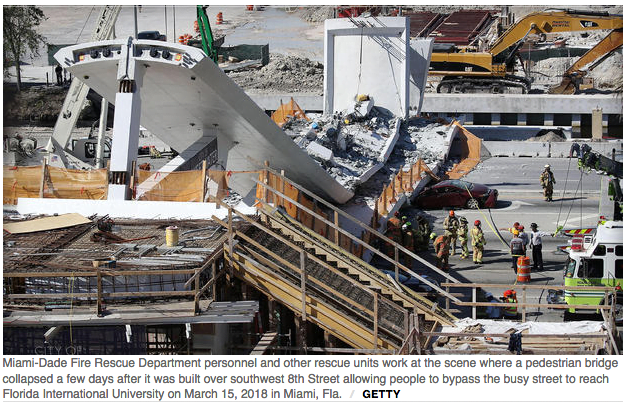
MIAMI — Construction of the pedestrian bridge that collapsed and killed six people in the Miami area was behind schedule and millions over budget, in part because of a key change in the design and placement of one of its support towers. Documents obtained by The Associated Press through a public-records request show that the Florida Department of Transportation in October 2016 ordered Florida International University (FIU) and its contractors to move one of the bridge’s main support structures 11 feet north to the edge of a canal, widening the gap between the crossing’s end supports and requiring some new structural design.

Engineer flagged “cracking” in Miami bridge 2 days before deadly collapse

The span’s signature, 109-foot-tall pylon was to be built atop a footing, or base, at the northern end of the span. In addition to basic support, its design was also aimed at contributing to the aesthetics of the bridge, which itself was touted as an architectural marvel that would span a busy road and canal to connect the rapidly growing university to the nearby community of Sweetwater. In their winning 2015 proposal, designers said the bridge provided “spectacular views” for both pedestrians using the bridge and drivers passing beneath it. And they added that the tower could serve as a safety feature because it provided an “eagle-eyed location” for additional lighting and security cameras.

Continue reading the full article…