
RSS feed source: US Computer Emergency Readiness Team

Summary

The Cybersecurity and Infrastructure Security Agency (CISA) is releasing this advisory in response to ransomware actors leveraging unpatched instances of a vulnerability in SimpleHelp Remote Monitoring and Management (RMM) to compromise customers of a utility billing software provider. This incident reflects a broader pattern of ransomware actors targeting organizations through unpatched versions of SimpleHelp RMM since January 2025.

SimpleHelp versions 5.5.7 and earlier contain several vulnerabilities, including CVE-2024-57727—a path traversal vulnerability.1 Ransomware actors likely leveraged CVE-2024-57727 to access downstream customers’ unpatched SimpleHelp RMM for disruption of services in double extortion compromises.1 

CISA added CVE-2024-57727 to its Known Exploited Vulnerabilities (KEV) Catalog on Feb. 13, 2025.

CISA urges software vendors, downstream customers, and end users to immediately implement the Mitigations listed in this advisory based on confirmed compromise or risk of compromise.

Download the PDF version of this report:

AA25-163A Ransomware Actors Exploit Unpatched SimpleHelp Remote Monitoring and Management to Compromise Utility Billing Software Provider (PDF, 420.49 KB ) Mitigations

CISA recommends organizations implement the mitigations below to respond to emerging ransomware activity exploiting SimpleHelp software. These mitigations align with the Cross-Sector Cybersecurity Performance Goals (CPGs) developed by CISA and the National Institute of Standards and Technology (NIST). The CPGs provide a minimum set of practices and protections that CISA and NIST recommend all organizations implement. CISA and

Click this link to continue reading the article on the source website.
RSS feed source: US Computer Emergency Readiness Team

Published by CBS News March 20,2018

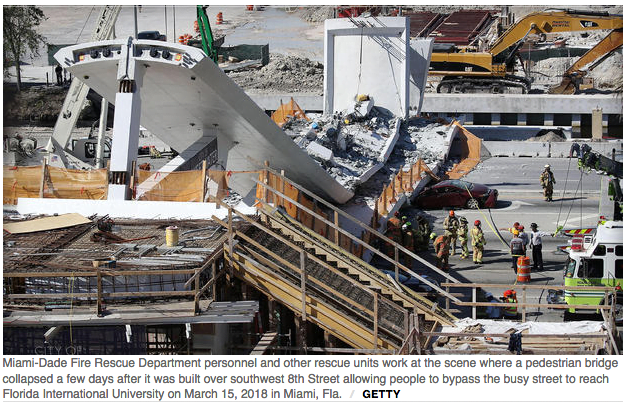
MIAMI — Construction of the pedestrian bridge that collapsed and killed six people in the Miami area was behind schedule and millions over budget, in part because of a key change in the design and placement of one of its support towers. Documents obtained by The Associated Press through a public-records request show that the Florida Department of Transportation in October 2016 ordered Florida International University (FIU) and its contractors to move one of the bridge’s main support structures 11 feet north to the edge of a canal, widening the gap between the crossing’s end supports and requiring some new structural design.

Engineer flagged “cracking” in Miami bridge 2 days before deadly collapse

The span’s signature, 109-foot-tall pylon was to be built atop a footing, or base, at the northern end of the span. In addition to basic support, its design was also aimed at contributing to the aesthetics of the bridge, which itself was touted as an architectural marvel that would span a busy road and canal to connect the rapidly growing university to the nearby community of Sweetwater. In their winning 2015 proposal, designers said the bridge provided “spectacular views” for both pedestrians using the bridge and drivers passing beneath it. And they added that the tower could serve as a safety feature because it provided an “eagle-eyed location” for additional lighting and security cameras.

Continue reading the full article…

Click this link to continue reading the article on the source website.

RSS feed source: US Computer Emergency Readiness Team

Source: CNN

The latest figure comes from a report by the American Road and Transportation Builders Association, a group that advocates for strong investment in transportation infrastructure. Using data from the Federal Highway Administration, the group releases an annual Deficient Bridge Report.

This year’s report, looking at data from 2017, found:

  • There are 612,677 bridges in the United States.
  • Of them, 54,259 are “structurally deficient,” which means they have at least one key structural element in poor condition.
  • That’s almost 9% of all US bridges, and the figure includes famous ones like the Arlington Memorial Bridge and the Brooklyn Bridge.
  • Americans cross these structurally deficient bridges 174 million times each day.

The report found that the largest number of defective bridges are in:

  • Iowa
  • Pennsylvania
  • Oklahoma
  • Missouri

States with the smallest number of structurally deficient bridges are: Hawaii Delaware Nevada

What it means to be structurally deficient

Bridges are regularly rated for safety on a scale of 0 to 9, with 9 meaning “excellent.” In order to be considered structurally deficient, one of its major components must measure 4 or below. Being structurally deficient does not necessarily mean that the bridge is unsafe, but it does mean it’s in need of repair. Repairing the deficiencies is critical. Deteriorating bridges can lead to road closures…

Continue reading on the source website

Click this link to continue reading the article on the source website.